
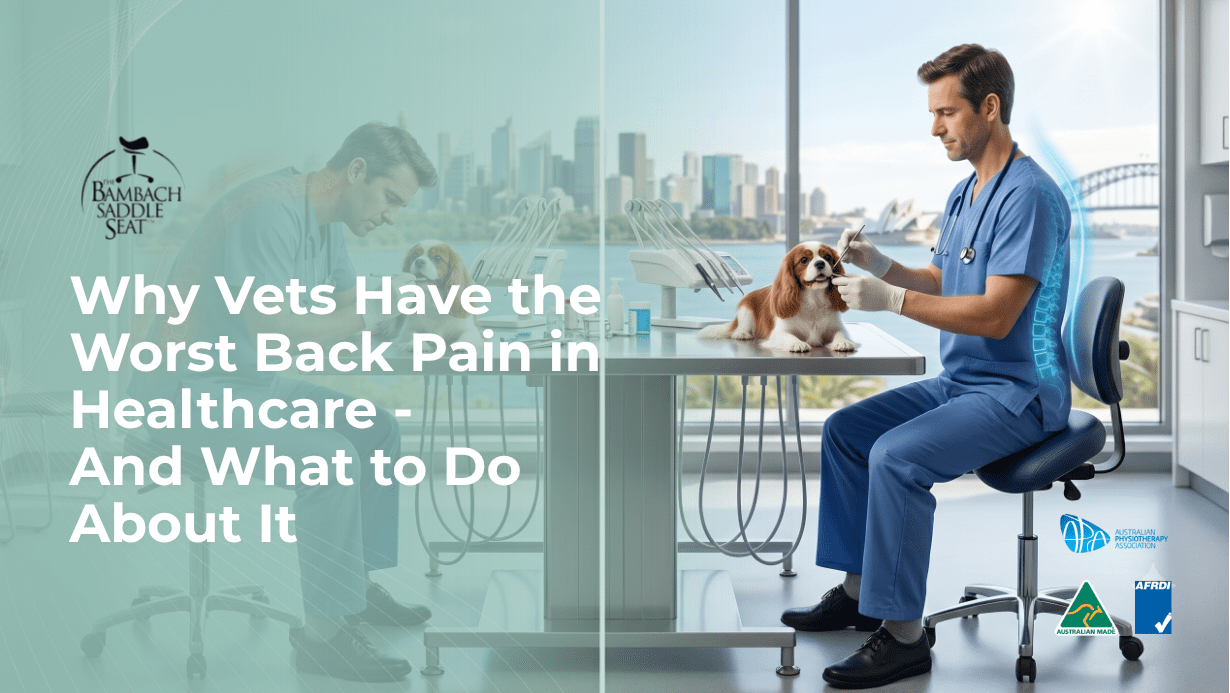
The 67% Crisis – Why Veterinary MSD Rates Shock Even Clinicians
Most healthcare workers know their profession is physically demanding. But ask them which clinical specialty carries the highest rate of work-related musculoskeletal disorders (MSDs) — the chronic injuries to muscles, tendons, nerves, and spinal structures that accumulate from occupational posture — and most will not answer: veterinary medicine.
They should. Research consistently identifies that approximately 67% of veterinary surgeons are affected by work-related MSDs during their careers. In some studies, rates of neck and shoulder pain among practising vets exceed 80%. Back pain is so endemic in the profession that many veterinarians describe it not as an injury but simply as a condition of the job — an assumption that deserves urgent clinical challenge.
These are not minor aches. MSDs are the leading cause of early career exit in veterinary medicine. A 2019 survey by the Australian Veterinary Association found that physical injury and chronic pain ranked among the top drivers of reduced working hours and premature retirement. A career that takes a decade to build and hundreds of thousands of dollars to qualify for is being cut short by a problem that is, in large part, biomechanically preventable.
“Physical injury and chronic pain rank among the top drivers of reduced working hours and premature retirement in veterinary medicine — yet the postural root cause is largely preventable.” — Australian Veterinary Association, workforce and wellbeing research
The Biomechanics of Vet Back Pain — Why the Examination Table Is the Enemy
To understand why veterinary practice is so damaging to the spine, you need to understand what happens mechanically when a clinician sits on a standard flat stool and leans forward to examine or treat a patient.
What happens on a flat stool
On a conventional flat seat, the hip angle sits at approximately 90°. This angle forces the pelvis to rotate backward — a position called posterior pelvic tilt. The moment the pelvis tilts posteriorly, it pulls the lumbar spine into flexion, collapsing the natural inward curve (lordosis) of the lower back into a rounded, “C”-shaped posture.
In this position, the intervertebral discs — the gel-filled shock absorbers between vertebrae — are compressed asymmetrically. The posterior portion of each disc bears disproportionate load. When this compression is sustained across a full consulting day of 8–12 hours, disc material is progressively pushed outward, dehydrated, and degraded. Over months and years, this is the mechanical process that produces disc herniation, facet joint arthritis, and the chronic lower back pain that ends veterinary careers.
Now add the forward lean. Veterinary examination requires practitioners to lean over tables, peer closely at patients, perform fine procedures with elevated arms, and sustain these positions for minutes at a time across dozens of consultations per day. Each degree of forward lean exponentially increases the compressive load on the lumbar discs — a load already elevated by the posterior pelvic tilt of the standard stool. The neck compensates by extending forward to maintain visual field, loading the cervical discs. The shoulders protract to reach the patient, loading the trapezius and rotator cuff tendons. The entire postural chain is under duress simultaneously.
Flat Stool vs. Bambach Saddle Seat — Hip Angle Comparison
| Standard Flat Stool | Bambach Saddle Seat | |
| Hip angle | ~90° | ~135° |
| Pelvic position | Posterior tilt | Neutral / forward tilt |
| Lumbar curve | Collapsed — “C” shape | Natural S-curve restored |
| Disc loading | Asymmetric compression | Even distribution |
| Muscle activation | Passive — structures fatigue | Active, low-level — sustainable |
Why repetition accelerates the damage
A full-time veterinarian in a busy mixed or small-animal practice may spend 70–80% of each working day seated at examination tables or surgical stations. The sustained, repetitive nature of this loading — not any single traumatic incident — is what drives the alarming MSD prevalence rates. The spine’s structures do not fail suddenly; they degrade incrementally, until one ordinary consultation produces a pain response that marks the end of capacity.
How Vets Compare to Other Healthcare Workers — And Why the Gap Is Striking
| Clinical Profession | MSD Prevalence | Primary Injury Sites | Primary Postural Driver |
| Veterinary surgeons | ~67% | Lumbar spine, neck, shoulder | Forward lean over variable-height patients and tables |
| Dentists | ~64% | Neck, shoulder, lower back | Sustained lateral rotation over fixed chair-height patient |
| Surgeons (human) | ~53% | Neck, lower back, shoulder | Static standing posture with fine motor precision |
| Nurses | ~45–52% | Lower back, neck | Patient handling, awkward lifting |
| GPs / General practitioners | ~30–40% | Neck, upper back | Computer workstation posture, examination lean |
Veterinary practitioners face a unique combination of postural challenges that other clinicians do not. Unlike dentists, who work on patients at a fixed, standardised height, vets treat patients ranging from a mouse on a bench to a 40kg dog on an examination table of varying height to a horse requiring ground-level examination. This constant adaptation — which forces repeated postural reconfiguration rather than a consistent posture — is a key driver of why vet MSD rates consistently lead clinical profession comparisons.
Dental professionals face analogous challenges — which is why Bambach’s dental ergonomic seating (bambach.com.au/ergonomic-back-support-seating/dental/) addresses the same biomechanical root cause — but the variability of veterinary practice adds an additional layer of complexity that makes seating adaptability a non-negotiable requirement.
Why Saddle Seating Is a Career-Extending Clinical Intervention — Not a Comfort Upgrade
The saddle chair’s core mechanism is simple but profound: by changing the shape of the seat surface from flat to saddle-contoured, the thighs are caused to drop downward and outward rather than resting horizontal. This single geometric change opens the hip angle from approximately 90° to 110–135°, which tips the pelvis forward into its neutral position — the position that allows the lumbar spine to reassume its natural lordotic curve spontaneously, without muscular effort or conscious postural correction.
The implications for a veterinary clinician are significant across four dimensions:
- Spinal alignment — Lumbar lordosis restored passively, without requiring the clinician to brace or consciously “sit up straight.” The correct posture is the position of least resistance, not maximum effort.
- Clinical mobility — The wide straddle stance anchors the clinician firmly to the floor while allowing 360° rotation around the examination table. This is particularly valuable in veterinary practice where moving around the patient is constant.
- Surgical precision — A stable pelvis removes tension from the shoulder girdle, reducing the muscle tremor that undermines fine motor procedures. Suturing, dental extractions, and ophthalmic procedures all benefit from this stability.
- Fatigue reduction — The open chest posture improves breathing and circulation across long consulting shifts, reducing both physical fatigue and the cognitive fatigue that accumulates when the body is working against its own postural load.
The Bambach Saddle Seat (bambach.com.au/ergonomic-back-support-seating/veterinary-ergonomic-seating/) is the original saddle seat — designed by Australian Occupational Therapist Mary Gale, AFRDI Level 6 certified, APA endorsed, and trusted by more than 300 veterinary practices across Australia. It is the only saddle seat custom-made in four distinct sizes to suit different body types and pelvic widths, and the only one specifically configured for the height and infection-control requirements of veterinary clinical environments.
Vet Clinic Buyer’s Checklist — What to Evaluate Before You Purchase
Not all ergonomic seating marketed to healthcare professionals is appropriate for veterinary clinic use. Use this checklist when evaluating any saddle chair for your practice.
Infection Control & Materials
- ☐ Surgical-grade vinyl upholstery that withstands chlorhexidine, bleach solutions, and quaternary ammonium compounds
- ☐ Seamless or minimal-seam construction to eliminate biological material harbours
- ☐ Non-porous, fluid-impermeable seat surface for wet-area and surgical theatre use
Height Range & Adjustability
- ☐ Multiple gas stem height options covering a wide range (typically 44–70cm+ seat height)
- ☐ Low-position capability for ground-level or floor-based examination
- ☐ Pneumatic gas-lift height adjustment — not screw-thread — for rapid one-hand reconfiguration between patients
Fit & Certification
- ☐ Minimum three to four seat sizes available — single-size saddle seats are a clinical compromise
- ☐ AFRDI Level 6 certification — independent structural integrity verification for commercial clinical use
- ☐ APA (Australian Physiotherapy Association) endorsement
Durability & Commercial Use
- ☐ Minimum 5-year commercial warranty — domestic warranties are insufficient for multi-shift clinical use
- ☐ Castor type appropriate for clinic flooring (hard rubber for tile/vinyl; carpet castors for carpeted rooms)
- ☐ 30-day money-back guarantee — any supplier confident in clinical performance should offer one
Bambach Saddle Seat · 7/87 Fitzroy St, Marrickville NSW 2204 · +61 2 8966 4800 · bambach.com.au
Can switching to a saddle chair actually prevent work-related MSD injury in veterinary practice?
The evidence strongly supports saddle seating as a preventive ergonomic intervention. By restoring the pelvis to its neutral position, the saddle seat prevents the posterior pelvic tilt that drives lumbar disc compression on a standard stool. It does not guarantee injury-free practice — workstation height, patient positioning, and rest breaks all contribute — but removing the seating root cause of lumbar loading eliminates the single most controllable postural driver of vet MSD injury.
Is a saddle chair appropriate for use in surgical theatres and wet prep areas?
Yes, provided the chair is upholstered in surgical-grade vinyl. The Bambach veterinary saddle seat is available in surgical-grade vinyl that resists bodily fluids and withstands hospital-grade cleaning chemicals — making it suitable for operating theatres, wet prep areas, and dental procedure suites within a veterinary practice.
How does saddle seating differ from a kneeling chair or balance ball?
Kneeling chairs load the knees and shins, creating new pressure points during long sessions. Balance balls offer no height adjustability and no clinical certifications. Saddle seating opens the hip angle through geometry alone — no instability, no additional joint loading, full height adjustability, and independently certified structural integrity for commercial clinical use.
Does a saddle chair help if I already have existing back pain from years of practice?
Saddle seating is frequently prescribed as part of occupational rehabilitation for existing spinal conditions, including disc pathology and facet joint degeneration. The Bambach is endorsed by the Australian Physiotherapy Association and commonly recommended for practitioners managing existing lower back pain. Consult your occupational therapist or physiotherapist about suitability for your specific clinical presentation.
What is the difference between the Bambach veterinary saddle seat and the dental saddle stool?
Both share the same core saddle geometry and postural mechanism — the clinical root cause they address is identical. The primary differences lie in height range options (veterinary configurations extend across a wider range to accommodate more varied table heights) and potentially in base configuration for different clinical flooring. Both are available in surgical-grade vinyl. The Bambach team can advise on the right configuration for your workflow.
See the dental saddle chair at bambach.com.au/ergonomic-back-support-seating/dental/.