Case Studies

sonographer shoulder pain

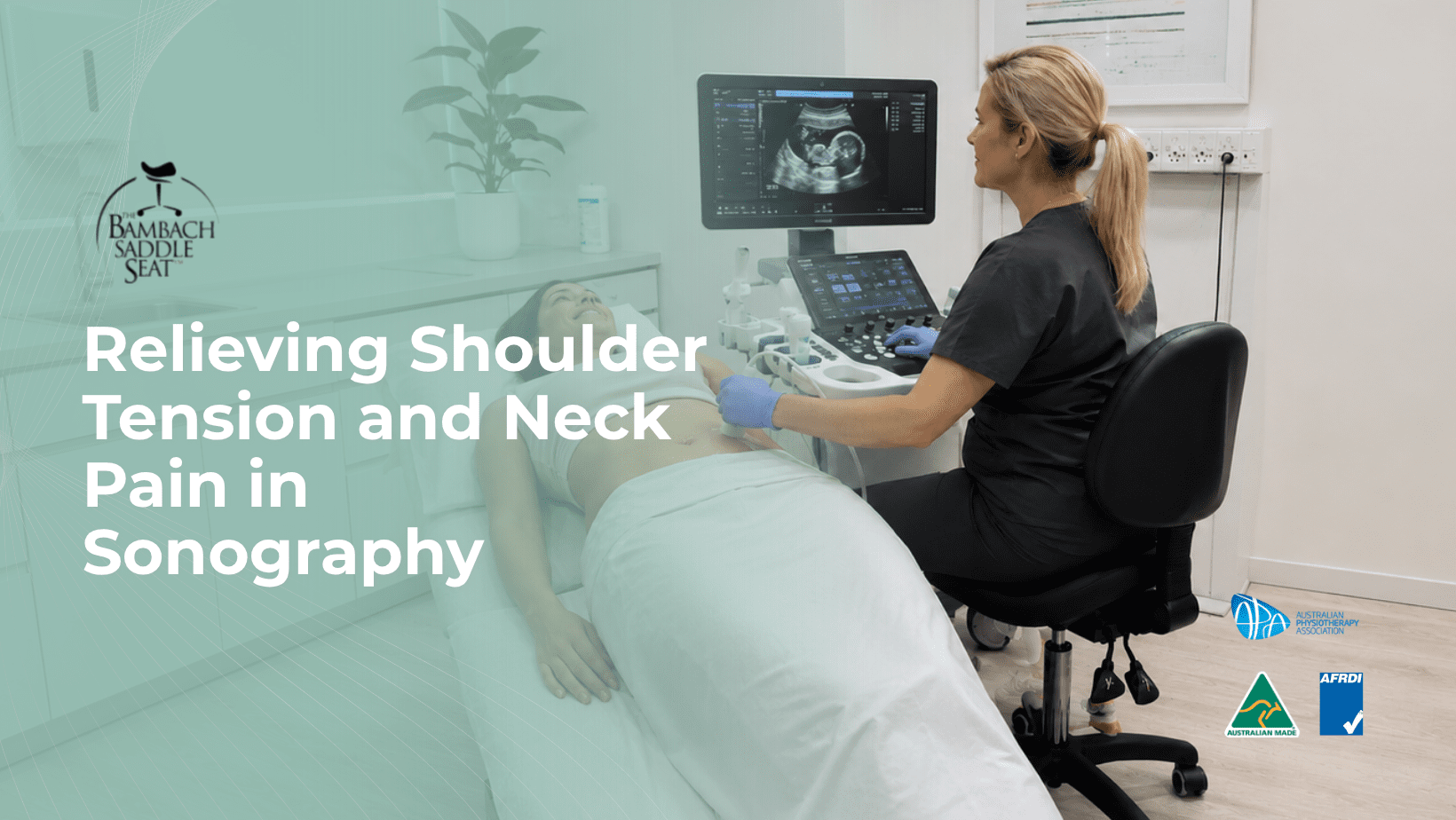
Case Study: Relieving Shoulder Tension and Neck Pain in Sonography

Sonographer: Shoulder Tension & Pain

Name: Samantha Everett, Occupation: Sonographer

The Problem

Samantha Everett, a Sonographer at Rosie Maternity Hospital, spends her shifts performing a high volume of ultrasound scans. Her daily routine requires greeting patients, discussing real-time ultrasound imaging on a screen, and following up with written computer reports.

Crucially, the physical act of scanning requires prolonged sitting while simultaneously twisting, turning, and manipulating the ultrasound probe with one arm. Maintaining this static, asymmetrical posture on a standard clinical stool caused Samantha to develop severe muscle tension in the shoulder of her scanning arm, alongside chronic, radiating pain through her neck and bilateral shoulders. The severity of her discomfort prompted a referral to Occupational Health for a comprehensive ergonomic intervention.

The Intervention

Following the ergonomic review by Occupational Health, Samantha was prescribed a Bambach Saddle Seat to address the specific biomechanical hazards of sonography.

Because sonographers must lean sideways and twist to reach the patient while looking at a monitor, a standard flat stool provides zero pelvic stability, forcing the shoulder and back muscles to bear the entire twisting load. The Bambach Saddle Seat fundamentally changed Samantha’s base of support. By opening her hip angle to 135 degrees and stabilizing her pelvis in a straddle stance, the seat locked her spine into its natural “S” curve. This allowed her to pivot and reach safely from her core, rather than twisting and straining her shoulder girdle.

The Outcome

  • Relief of Shoulder Tension: By stabilizing her core and perfectly balancing her upper spine, the Bambach took the strain off the overworked muscles in her scanning arm and shoulder, providing immense relief from chronic tension.

  • Supported Mobility: The straddle position allowed Samantha to easily roll around the examination room—from the patient bed to the computer workstation—without compromising her posture.

  • Occupational Health Endorsement: Samantha’s case demonstrates why standard flat stools fail in active clinical environments, proving that task-specific ergonomic seating is a critical necessity for ultrasound professionals.


On a normal flat stool, twisting comes from the lower back and shoulders, which causes immediate strain. A saddle chair anchors the pelvis in a secure straddle position. This allows the sonographer to move closer to the patient bed and pivot their entire torso as a single, stable unit, preventing hazardous spinal twisting and shoulder overextension.

Yes. The Bambach Saddle Seat is designed to support the spine perfectly regardless of the task. Because it maintains an upright, chest-open posture, it is just as effective for typing up post-scan reports at a desk as it is for performing dynamic ultrasound procedures.
cerebral palsy seating

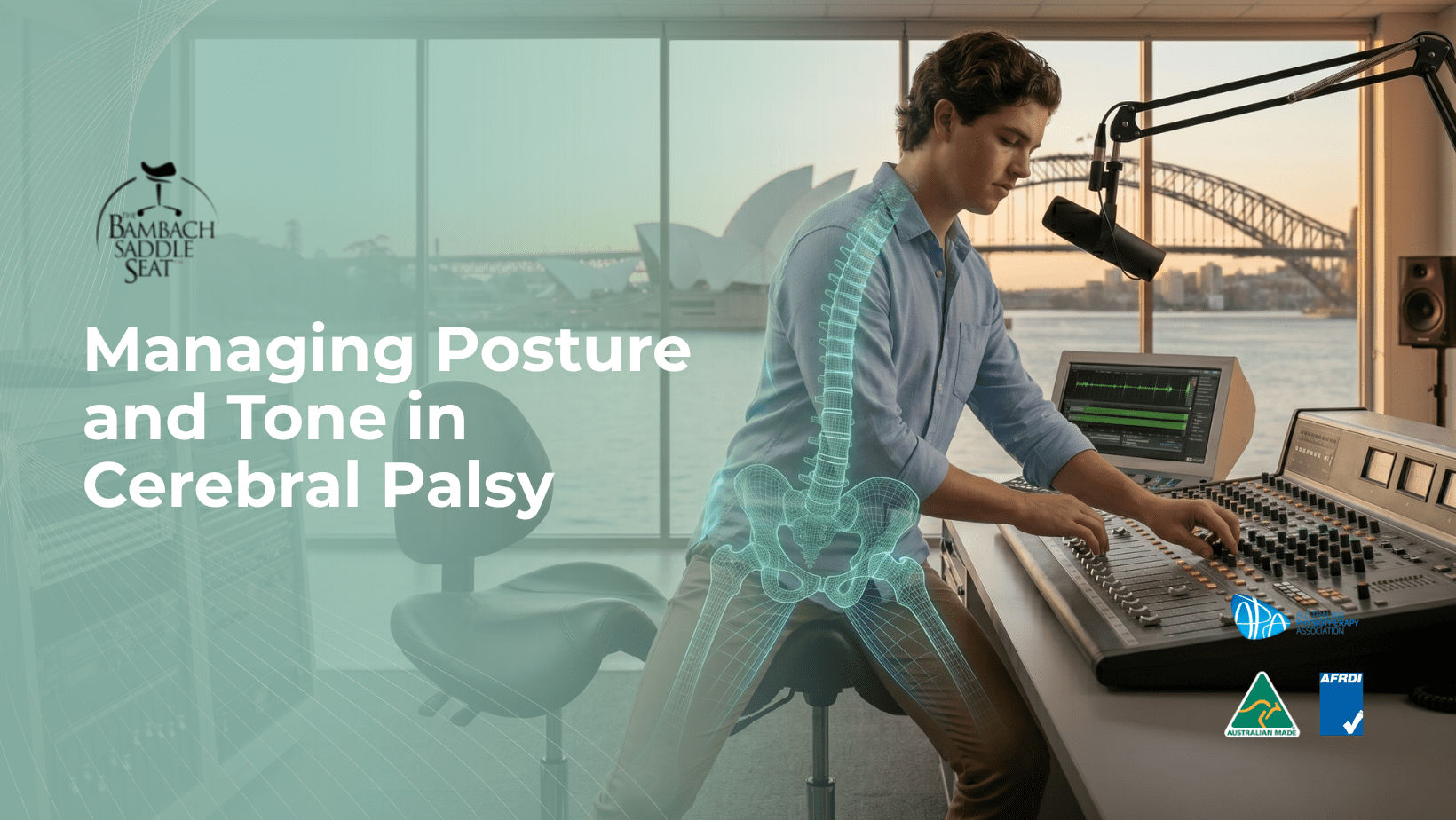
Case Study: Managing Posture and Tone in Cerebral Palsy

Special Needs: Cerebral Palsy

Name: David Boyle; Occupation: Student; part-time radio presenter (rock music)

The Problem

David Boyle, a student and part-time rock music radio presenter, lives with Cerebral Palsy characterized by increased muscle tone, particularly on his right side. His condition includes tight hip adductors, making walking extremely difficult and necessitating the use of a wheelchair for mobility.

When sitting in his wheelchair or a conventional seat, David tends to sit “sacrally” (slumped back on his tailbone). This posterior pelvic tilt causes a chain reaction of poor postural habits: his shoulders hunch forward, his shoulder blades become “winged,” his chin protrudes, and his cervical spine falls into excessive lordosis (inward curvature). Furthermore, the asymmetrical muscle tone causes his pelvis to pull obliquely to the right. This poor seating posture severely impacted his comfort, upper body mobility, and his ability to work effectively at his radio broadcasting desk.

The Intervention

To address these complex seating challenges, David was introduced to a custom-fitted Bambach Saddle Seat.

The unique saddle shape provided an immediate structural intervention. The seat’s contour naturally forced David’s tight hip adductors into an abducted (open and apart) position. By straddling the seat, his pelvis was actively prevented from slipping into a sacral slump and was instead guided into a neutral, anterior tilt. This foundation automatically stabilized his core and broke the pattern of asymmetrical pulling, correcting the oblique shift of his pelvis.

The Outcome

  • Corrected Spinal Alignment: By anchoring the pelvis in a neutral position, the Bambach seat naturally stacked David’s spine. His hunched shoulders dropped back, his shoulder blades flattened, and his excessive cervical lordosis was corrected, allowing his head to balance easily over his neck.

  • Improved Upper Limb Function: With his core stabilized and his shoulders properly aligned, David gained much better control and reach with his arms—a critical improvement for operating the mixing desks and equipment during his radio broadcasts.

  • Tone Management: The abducted hip position helped to stretch his tight adductors and inhibit the increased muscle tone on his right side, providing therapeutic value even while he was simply sitting at his desk or presenting his show.


Yes. Upper limb function is heavily dependent on core and shoulder stability. When a conventional chair allows the spine to slump, the shoulder blades wing out, making fine motor tasks difficult. The Bambach Saddle Seat stabilizes the pelvis and spine, giving the arms a solid base of support to operate from, which significantly improves reach and dexterity.

No. A wheelchair is essential for mobility and transport. However, for task-specific activities—such as studying at a desk, eating at a table, or working in a studio—transferring to a Bambach Saddle Seat provides an active, therapeutic seating environment that counters the negative postural effects of prolonged wheelchair use.

muscular atrophy seating

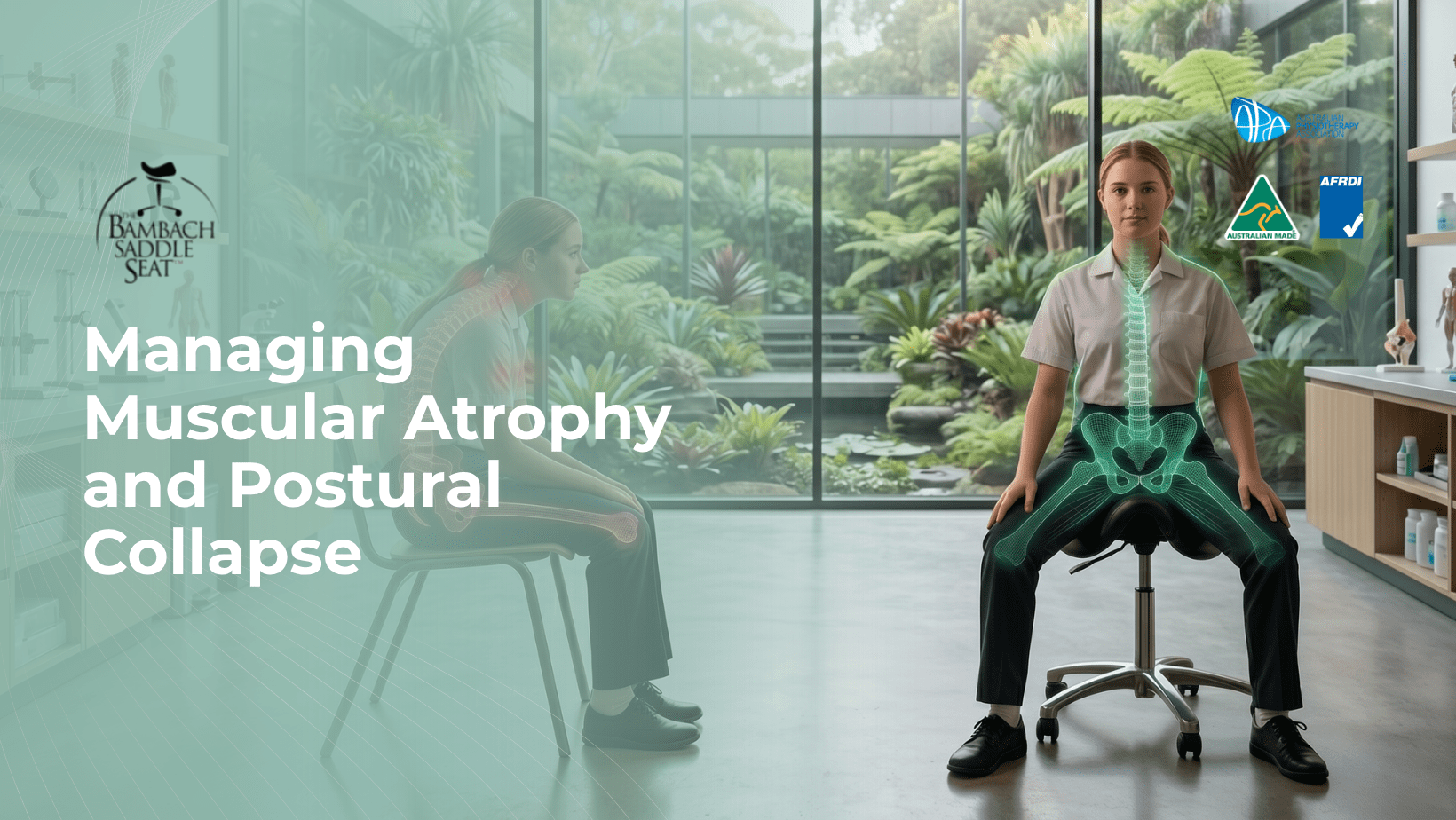
Case Study: Managing Muscular Atrophy and Postural Collapse

Special Needs: Muscular Atrophy

Name: Ruby Neale; Occupation: Student

The Problem

Ruby Neale, a student living with muscular atrophy, faces significant challenges maintaining functional posture, particularly over long periods in a standard classroom chair. The conventional seat forces her into a severe, C-shaped postural collapse that flattens her natural lumbar curve. This places her at a high risk of developing permanent kyphotic or spinal deformities. To compensate for this slump and see her desk work, Ruby’s shoulders hunch forward, her neck severely hyperextends, and her chin protrudes.

Furthermore, this postural collapse has secondary systemic effects. Her chest caves down onto her abdomen, mechanically restricting the action of her diaphragm and ribs. This impaired thoracic function drastically accelerates her physical fatigue and makes performing standard, functional classroom tasks incredibly difficult.

The Intervention

To counter the profound gravitational pull and lack of muscular support, Ruby was assessed for and provided with a custom-fitted Bambach Saddle Seat. The continuous, equestrian-inspired contour of the seat intervened structurally at the pelvis. By naturally abducting her legs and securely holding her pelvis in an upright, neutral tilt, the seat provided the skeletal foundation her muscles were struggling to maintain.

The Outcome

  • Spinal Deformity Prevention: By locking the pelvis in an anterior tilt, the Bambach seat naturally restored Ruby’s healthy lumbar curve, immediately breaking the dangerous C-shaped slump and mitigating the risk of kyphotic progression.

  • Restored Thoracic Function: Lifting the spine out of its collapsed state opened Ruby’s chest cavity. This removed the physical compression on her abdomen, allowing her diaphragm and ribs to move freely and significantly reducing her daily physical fatigue.

  • Functional Alignment: With her torso safely anchored, Ruby’s shoulders naturally dropped back. Her head could now balance effortlessly over her spine without requiring painful neck hyperextension, granting her the stable, comfortable base needed to focus on her education.


Yes. When a person slumps, their ribcage collapses down onto their abdomen, physically restricting the diaphragm and making breathing incredibly labor-intensive. By naturally holding the user upright, the Bambach seat opens the thoracic cavity, allowing the lungs and diaphragm to expand fully. This deeper, easier breathing significantly reduces daily physical fatigue.

Beyond preventing long-term spinal deformities, the seat stabilizes the torso, which naturally aligns the head and neck. Instead of jutting her chin forward and hyperextending her neck just to see the whiteboard or her desk, Ruby can look forward comfortably. This core stability also frees up her arms and hands, making writing and functional classroom tasks much easier to perform.

spastic quadriplegia seating

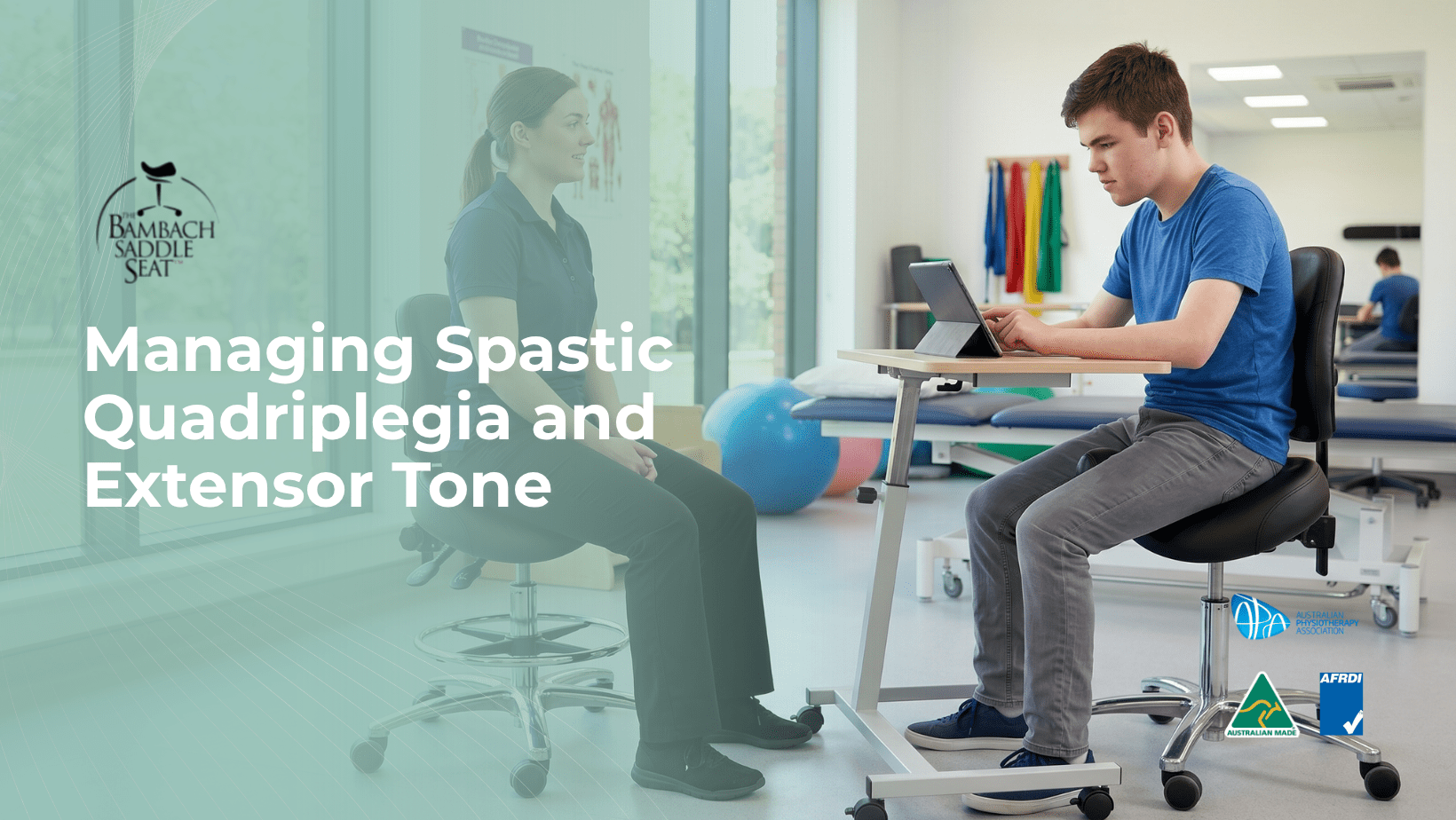
Case Study: Managing Spastic Quadriplegia and Extensor Tone

Special Needs: Spastic Quadriplegia Cerebral Palsy

Name: Eamon Hohn, Occupation: School student

The Problem

Eamon lives with moderate to severe spastic quadriplegia cerebral palsy. His condition is characterized by high spasticity and increased extensor tone, causing involuntary muscle tightness and thrusting. When sitting in a conventional flat seat, Eamon lacks the foundational support needed to manage this tone. Consequently, his pelvis and trunk tend to rotate obliquely, accompanied by a physical drop to his left side. This rotational instability, combined with his extensor thrust, causes him to continuously slide off standard chairs.

Despite experiencing physical restrictions in the activities he wishes to undertake, Eamon is fiercely determined. He rightly views himself as normal, noting that his primary obstacle is often “other peoples’ attitudes” rather than just his physical limitations. However, inadequate seating actively hinders his independence by forcing him to constantly battle gravity and his own muscle tone just to stay seated.

The Intervention

To address his complex postural instability, Eamon was fitted with a custom Bambach Saddle Seat. The continuous, unbroken contour of the saddle provided an immediate biomechanical intervention. By naturally abducting his hips (separating the legs) and securely cradling his pelvis, the seat’s design actively broke up his severe extensor thrust. The pommel and cantle system of the saddle locked his pelvis into a neutral, symmetrical position, physically preventing the oblique rotation and the left-sided drop that conventional flat seats allowed.

The Outcome

  • Elimination of Sliding: With his pelvis securely anchored by the saddle’s anatomical geometry, Eamon no longer slides out of his chair. He is safely and comfortably supported without the need for restrictive strapping that often accompanies conventional seating.

  • Tone Reduction: The abducted hip position naturally inhibited his high extensor tone, reducing the spasticity in his trunk and legs. This provided therapeutic relief and allowed his body to relax into the seat.

  • Empowered Independence: By removing the exhausting physical battle of simply trying to stay upright, Eamon gained the stability required to focus on functional tasks. The seat bridged the gap between his physical restrictions and his personal determination, giving him the secure foundation needed to engage in his desired activities with confidence.


Yes. Conventional chairs offer a flat surface, which provides no lateral or rotational control for the pelvis. The continuous, contoured design of the Bambach seat physically cradles the user's anatomy. The front pommel and the overall saddle shape lock the pelvis into a symmetrical, neutral alignment, actively preventing the hips from twisting obliquely or dropping to one side.

For individuals like Eamon, a lack of core stability means all their energy is spent just trying not to fall or slide. By anchoring the pelvis and managing involuntary spasticity, the Bambach seat frees up the upper body. This provides the stable platform necessary to improve arm control, breathing, and the ability to independently participate in daily activities.

spondyloepiphyseal dysplasia seating

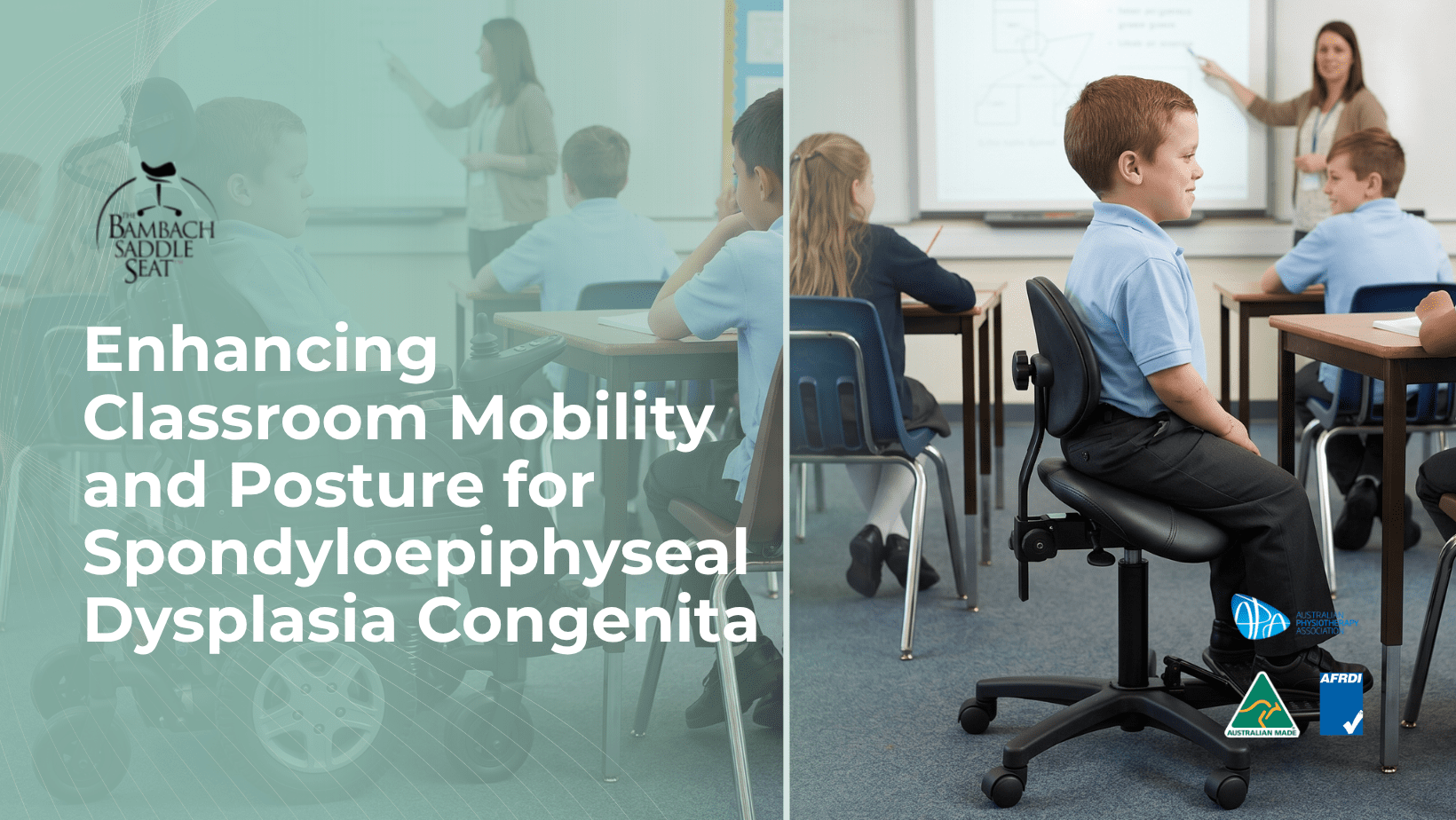
Case Study: Enhancing Classroom Mobility and Posture for Spondyloepiphyseal Dysplasia Congenita

Special Needs: S. E. Dysplasia Cogenita

Name: Patrick Tinney, Occupation: Student

The Problem

Patrick is a student living with spondyloepiphyseal dysplasia congenita, a condition that significantly impacts his daily physical function. His anatomy is characterized by malformed joints, alongside a shortening of both his limbs and his spine. Physically, this manifests as a severe limitation in his shoulder movement and marked upper thoracic restriction.

In the classroom, Patrick is usually confined to his electric wheelchair. While necessary for long-distance transport, the wheelchair is incredibly cumbersome in a standard schoolroom environment. Because of its bulk and his restricted upper body mobility, Patrick cannot simply turn his body to look at the whiteboard or interact with peers. Once his wheelchair is parked, he is effectively trapped in that single, forward-facing orientation, severely limiting his educational independence and social engagement.

The Intervention

To liberate Patrick from the confines of his heavy wheelchair during class time, he was introduced to a custom-configured Bambach Saddle Seat. Because standard chairs cannot accommodate his shortened limbs, the Bambach was fitted with a customized stem and foot-support system, allowing him to safely mount and anchor himself. The continuous saddle contour naturally cradled his pelvis, providing an ultra-stable core foundation that his malformed joints previously struggled to establish on flat surfaces.

The Outcome

  • Classroom Independence: By transferring to the Bambach seat, Patrick immediately reduced his spatial footprint in the classroom. The seat’s compact design and castors allowed him to navigate between desks freely, giving him an unprecedented level of independence.

  • Restored Field of Vision: The secure pelvic anchor provided by the saddle allowed Patrick to use his core to pivot his entire body as a single unit. He was finally able to rotate his seat to face the whiteboard, the teacher, or his classmates without needing to maneuver a heavy electric wheelchair.

  • Optimized Thoracic Function: By stabilizing his lower body in an upright, neutral posture, the seat alleviated the compensatory strain on his upper body. Lifting his shortened spine out of a slumped wheelchair posture maximized his available thoracic space, reducing restriction and allowing him to utilize his limited shoulder movement more efficiently.


While electric wheelchairs are vital for overall mobility, their bulk often creates physical barriers in tight environments like classrooms. The Bambach seat provides a much smaller footprint, allowing the student to sit at standard desks with their peers. Furthermore, the seat's swivel function and castors allow the user to easily rotate to see the teacher or the board—a movement that is often impossible when parked in a heavy wheelchair.

Yes. When a user is confined to a standard flat chair or a wheelchair, they often slump forward, which physically compresses the ribcage and restricts the shoulders. By locking the pelvis into a natural, upright tilt, the Bambach seat lifts and lengthens the spine. This naturally opens the thoracic cavity, maximizing the user's available range of motion in their shoulders and upper back.